Research
Central bank communication of uncertainty
A narrative approach of central bank sentiment assessment

In this project we investigate the South African Reserve Bank's communication in an uncertain environment when announcing its policy rate decision. With the help of published monetary policy committee (MPC) statements, we use a narrative approach to build a dictionary that helps create an index of central bank communication sentiment in terms of uncertainty and confirmation of expectations. Furthermore, we assess whether these sentiments contain information in explaining monetary policy decision.
In the second part of this project, we develop an index of crosswire that captures the mismatch between central bank communication and its media perception around MPC meetings.Labour market flows and heterogeneity
Public and private sector job flows, household heterogeneity and skill gap
This project investigates labour market flows in a search and matching setting while accounting for the following features: (i) public and private sector heterogeneity, (ii) capital-skill complementarity and embodied technological progress, and (iii) households and workers heterogeneity. We also assume a skill gap in this model to analyse changes in labour flows due to productivity increases and public wage premium.
Further, we plan to model on-the-job search a la Moreno-Glabis and Sneessens (2007) between simple and complex jobs (for skilled individuals) and between public and private sector jobs (for all individuals). The heterogeneity between public and private sector follows the framework by Gomes (2018).
Hysteresis and the labour market
High persistence unemployment response to shocks

We investigate hysteresis in the labour market using two approaches. First we use the Preisach model - a mathematical framework for hysteresis in physics and electromagnetism - to derive an index of hysteresis in the unemployment data where only long lasting shocks remain in the memory bank of the series (see Piscitelli, Cross, Grinfeld, and Lamba (2000)).
Second, we use a DSGE model a la Blanchard and Gali (2010) which we extend on two fronts: (i) we account for the external sector following Gali and Monacelli (2005); (ii) we use the framework of Gali (2015) that introduces hysteresis in the labour market in a DSGE setting. This allows us to derive a marginal cost of firms that depends directly on labour market variables (unemployment in particular), on the hysteresis parameter and on terms of trade shocks.
We completed the first part of the project and published a paper in the South African Journal of Economics.
Mobile Money in the era of cryptocurrencies
The centrak bank digital currency potential of Mobile Money

We study the evolution of Mobile Money on the African continent since its implementation in the early 2000s pioneered through M-Pesa in Kenya, and we investigate its potential to become a digital currency. This is an interesting area to explore for the conduct of monetary policy in a world dominated by cryptocurrencies and the debates surrounding Central Bank Digital Currency (CBDC). Aggregate data obtained from GSMA allowed us to draw rough conclusions to help us consolidate our priors.
The next step involves partnering with the mobile operator Orange to obtain more disaggregated and significantly rich data which we intend to analyse on multiple fronts. That includes - but not limited to - a panel data analysis and a geospatial analysis that will give us a bird’s eye view of the evolution of the transactions using Mobile Money through time.
This project is part of an international network of researchers with the goal of investigating digital currencies in central banks. The Laboratoire d'Economie Rouen Normandie LERN of the University of Rouen leads the initiative.
Fiscal policy and commodity price shocks
Commodity dependence and fiscal discipline
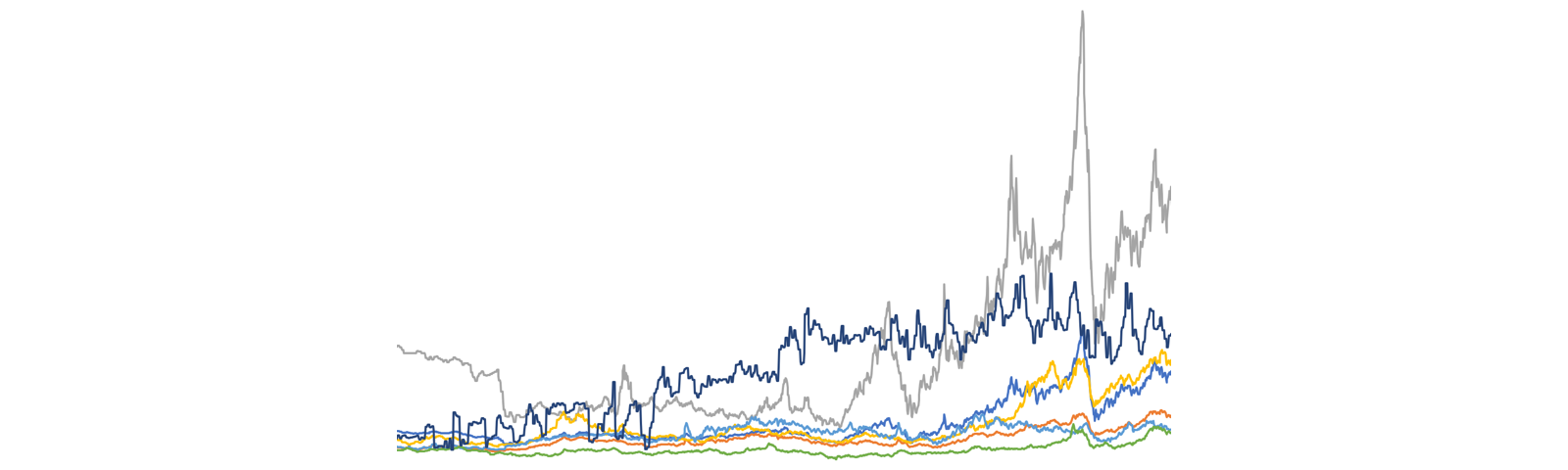
How does fiscal policy affect the response of real GDP and unemployment to global shocks in South Africa? This question is relevant for a country with high structural unemployment; prolonged periods of low economic growth; and tax revenue that is vulnerable to commodity shocks. To answer this question, we employ both an empirical and theoretical approach.
We contribute to the literature and the policy debate in two ways. Firstly, we model the effect of commodity shocks to corporate income tax revenue, and thus to the effect on South Africa's fiscal space. Secondly, we model the South African labour market by accounting for compelling features namely: (i) hysteresis to explain the exceptionally and persistently high level of unemployment prevailing in the economy, and (ii) a Susceptible-Exposed-Infected-Recovered epidemiological framework to model the disruptions in the labour force caused by the Covid-19 pandemic.
Funding for this research is provided by the South African National Treasury through UNU-WIDER. A paper has been delivered and published as a UN-WIDER Working Paper.